k2togtbl

After I posted the posts about the k2tog and the k3tog, which were not new but they were buried in the files with the patterns. Anyways, after posting those to tutorials, someone asked about a k2togtbl and what it meant.

Okay, a k2togtbl simply stands for a knit two stitches together (k2tog) through the back loop (tbl). In needle knitting, it means that you have to a decrease, similar to the k2tog. The only difference is that you have to knit the two stitches together through the back loops of the stitches. Knitting them through the back loops creates a Twisted Knit Stitch.

In loom knitting, we don't have to worry about the back loops or front loops since our stitches always sit facing the front with both legs of the stitch facing the front. To create a Twisted Knit Stitch in loom knitting, we e-wrap the peg and knit it with the single stitch. Thefore, to create the k2togtbl, in loom knitting, you will move the stitch from the first peg over to the second peg, then you will ewrap the 2nd peg. Second peg now has three loops on it. Next, you will lift the bottommost two loops up and off the peg. Ta-da!!! The k2togtbl has been created! 🙂

Pegs


Decreasing: k3tog or p3tog

It is a decrease that reduces from 3 stitches down to 1.

The k3tog creates a decrease that slants to the right.

When you do a k3tog, you need the third stitch to stay on top, meaning it needs to remain visible when you work it.

Let’s create a k3tog. Assume each of the pegs below have a stitch/loop on them.

Pegs

Step 1: Move loop from peg 2 over to peg 3.

Step 2: Move loop from peg 1 over to peg 3.
Peg 3 has three loops on it, loop from peg 3 (at the very bottom), loop from peg 2, and loop from peg 1 (at the very top, near the cap of the peg).

Step 3: Knit the stitch, treat all three loops on peg 3 as one loop.

The p3tog is exactly like the k3tog, except instead of KNITTING at Step 3, you would PURL.

Download K3TOG

Decreasing: K2TOG and SSK

When you decrease, you are removing stitches from your knitting making that area narrower.

K2TOG

The most common decrease is known as the k2tog (knit two stitches together).

The k2tog creates a decrease that slants to the right.

When you work a k2tog, you need the second stitch to stay on top, meaning it needs to remain visible when you knit it.

Let’s create a k2tog as follows: k1, k2tog.

How: Knit peg 1. Move the stitch from peg 2 to peg 3 (the k2tog takes place on these two pegs). Knit peg 3, be sure to lift the two loops off the peg (treat them as one loop).

Move the stitches inwards, and the decrease by 1 stitch has been created.
Pegs

SSK

The ssk creates a decrease that slants to the left (the opposite of a k2tog).

The ssk, stands for slip, slip, knit, which translates to loom knitting as skip, skip, knit. However, there is a small twist in our looming. We can’t translate this directly, you see on needles the stitches sit a certain way and the slipping of them changes their position, while on the loom the stitches sit always front facing (be it if we are purling or knitting).

How does it need to look: When you create a ssk, you need the first stitch to stay on top, meaning it needs to remain visible when you knit it.

Let’s create a ssk as follows: k1, ssk.

Pegs

How:
Knit peg 1.
Move the stitch from peg 3 to peg 2 (the ssk takes place on these two pegs).
Knit peg 2, be sure to lift the two loops off the peg (treat them as one loop).
Move the loop on peg 2 to peg 3.
Move the loop from peg 1 to peg 2, and the decrease by one stitch has been created.
Alternate method:

Knit peg 1
Lift loop from peg 3 and hold it with your fingers (or put it on the peg to the left).
Move the loop from peg 2 to peg 3
Get the loop you are holding and place it back on peg 3.
Knit peg 3. Be sure to lift the two loops off the peg (treat them as one loop). Move the stitches inwards and the decrease by one stitch has been created.

These two decreases are usually paired together. I like to knit a few stitches at each side before doing the decreases, this gives the edges a more finished look.

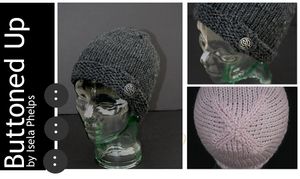
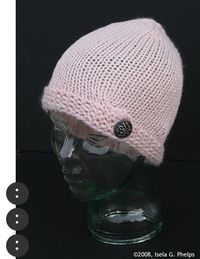
Buttoned Up Hat

Buttoned Up HatMaterials

Yarn: 75 yards of Chunky Weight acrylic blend yarn. Lion Brand Wool Ease Chunky was used in sample (1/2 skein) in Charcoal. 5oz/140g, (153yd/140m), 80% acrylic, 20% wool.

Loom: Purple Round Knifty Knitter Loom (48 pegs)

Notions: Knitting Tool, Tapestry Needle, cable needle/or stitch holder

Other: Button for decoration

Gauge: 13sts and 22 rows=4 inches in stockinette stitch

Size: Fits up to 20 inch head circumference
8 inches from cast on edge to crown

Skills Knowledge: knit stitch, purl stitch, flat panel knitting, k2tog, ssk (tutorial on the k2tog and ssk included)

 
Abbreviations
k=knit (with Knit Stitch or Flat Stitch or U-Stitch, not e-wrap)
p=purl
k2tog=knit two stitches together
ssk=slip, slip, knit

Pattern Notes: The first 8 rows are done as a flat panel. During these 8 rows, you will be working on 52 stitches, the last 4 stitches will overlap on the last 4 pegs, you will remove them as needed to work on the first 4 pegs. Please see video tutorial at this youtube link:  http://tinyurl.com/3kht2u

INSTRUCTIONS Buttoned Up Hat 2

Cast on 52sts (Yarn should end up on the left of anchor peg, ready to begin Row 1.

Row 1, 3, 5, 7: k
Row 2, 4, 6, 8: p
Row 9: BO4 at beginning of row, k to end of row (48sts remain)

End of Brim (measures 1.5 inches)

From this point forward you will be working in the round. When you reach the end of the row (at peg 48) simply take the yarn to peg 1 and continue with the instructions below.

Next: Work 26 rounds in stockinette stitch (knit every round)

Crown

Done in 4 flat panels (Follow panel instructions below).

Top will be divided into 4 sections, each one consisting of 12 pegs/stitches.

Panel 1 consists of pegs: 1-12
Panel 2 consists of pegs: 13-24
Panel 3 consists of pegs: 25-36
Panel 4 consists of pegs: 37-48

Finishing

Seam the panels with mattress stitch
If there is an opening at the very top, close it with the yarn coming from one of the panels.
Attach button to side brim of the hat

Follow panel instructions for each panel. Once each panel is complete, cut yarn leaving a 12 inch tail (used later for seaming). Once the yarn is cut from the previous panel, attach it to the first peg of the next panel (ei: peg 13, peg 25, peg 37).

Weave ends in. Block lightly.
 
Panel Instructions

Done on 12 pegs:

Row 1: k
Row 2: k
Row 3: k, k2tog, k to last 3sts, ssk, k
Repeat Rows 2 & 3 until 4sts remain
Next row: k
Next row: k2tog, ssk
Next row: k
Next row: k2tog
 
Download Buttoned Up Hat

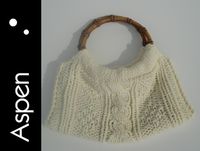
Aspen Baguette

Aspen BagThe Aspen Baguette is the perfect way to practice making cables. The project is small enough and yet provides you with a finished product that you can take anywhere with you.


Materials

Loom: Regular gauge knitting loom with 36 pegs.

Yarn: 120 yards of bulky weight wool. GGH Aspen was used in sample.

Notions: Tapestry needle, knitting tool, 4 stitch markers (2 of different color)

Other: D shape purse handles. Liner to line the bag (instructions to line the bag are not provided).

Size: 9.5 inches x 5.5 inches

Gauge: 13sts and 10 rows=4 inches in stockinette stitch

Skills knowledge: knit stitch, purl stitch, chain cast on, cast on at the beginning of a row, bind off at the beginning of a row.

Abbreviations
St st=Stockinitte stitch (knit every row)
K=knit stitch
P=pur stitch
GS=Garter stitch
Yo=yarn over (ewrap the peg)
St(s)=stitch (es)
C3F=Cable 6 stitches to the left (see special instructions)


Pattern Notes
•    Knitted as a flat panel going around the loom in a clockwise direction (from right to left).
•    The Knit Stitch refers to the knit stitch that is done like an upside down purl, however, you can knit the flat stitch instead.
•    Follow either the Chart or the Written Chart Instructions, be sure to familiarize yourself with the Special Technique (see below), and the abbreviations.

Special Techniques (see Special Techniques page for visual):
YO: E-wrap the peg

C3F: Cable 6 stitches. Trade places over the 6 stitches—the 3 stitches on the right will be traded first then the 3 stitches on the left.  To create the wide cables without stretching the yarn too much, I have devised a special method that implements elongated stitches (created with yarn overs). Before crossing the cables, we are going to knit them and create the elongated stitches to have enough slack in the stitches to cross them over (steps 1-5).

Steps 1 and 2 are the knitting and the elongating of the stitches.

[Stitches 1, 2, 3, 4, 5 and 6 (stitches on pegs 16-21)]

Step 1: k1, YO, [k1, YO2] 4 times, k1, YO,
Step 2: Drop all the YOs to elongate the 6 stitches.

Steps 3-5 are the actual crossing of the cables.

Step 3: Take stitches 1, 2, 3, off the pegs and hold them on a cable needle and let them sit towards the center of the loom
Step 4: Take stitch 4 and place it on the peg emptied by 1. Take stitch 5 and place it on the peg emptied by 2. Take stitch 6 and place it on peg emptied by 3.
Step 5: Place stitches from cable needle on the emptied pegs. Place them in this order: Stitch 1 on peg emptied by 4. Stitch 2 on peg emptied by 5. Stitch 3 on peg emptied by 6.

Written Chart instructions

Row 1-2: p3, k1, p1, k1, p7, k1, p1, k6, p1, k1, p7, k1, p1, k1, p3
Row 3-4: p3, k1, p1, k1, p3, k1, p3, k1, p1, k6, p1, k1, p3, k1, p3, k1, p1, k1, p3
Row 5: p3, k1, p1, k1, p2, k1, p1, k1, p2, k1, p1, k6, p1, k1, p2, k1, p1, k1, p2, k1, p1, k1, p3
Row 6: p3, k1, p1, k1, p2, k1, p1, k1, p2, k1, p1, C3F, p1, k1, p2, k1, p1, k1, p2, k1, p1, k1, p3
Row 7-8: p3, [k1, p1] 6 times, k6, [p1, k1] 6 times, p3
Row 9-10: p3, [k1, p1] 2 times, [p1, k1] 2 times, p2, k1, p1, k6, p1, k1, p2, [k1, p1] 2 times [p1, k1] 2 times, p3
Row 11: p3, k1, p1, k1, p3, k1, p3, k1, p1, k6, p1, k1, p3, k1, p3, k1, p1, k1, p3
Row 12: p3, k1, p1, k1, p3, k1, p3, k1, p1, C3F, p1, k1, p3, k1, p3, k1, p1, k1, p3

Aspen bag chart

INSTRUCTIONS

Cast on 30 stitches with chain cast on method, place stitch marker at first peg, and a matching color stitch marker at peg 30.  (Remember to have your loom ready to knit, start casting on at peg 30 and work to peg 1). Working yarn needs to be at peg 1 for Row 1. 

Row 1-12: Knit
Row 13: You should be by peg 1. E-wrap the next 3 empty pegs.
Row 14: Knit (33 sts)
Row 15: Yarn is by peg 30. E-wrap the next 3 empty pegs.
Row 16: Knit (36 sts)

First 3 sts and last 3 sts are selvedge sts: always purl them.  The middle 30 sts are the chart sts (from stitch marker to stitch marker): 36 sts total on loom.

Place the other set of stitch markers on peg 16 and peg 21, the cable is located on these 6 stitches.

Knit Chart Rows 1-12: 2 times

Knit Chart Row 1: 6 times

Knit Chart Rows 1-12: 2 times

Knit Chart Row 1: 2 times

Next row: Bind off 3 sts, then knit to end. (33 sts)
Next row: Bind off 3 sts, then knit to the end. (30 sts)

Knit 12 rows in st st.

Bind off loosely.

Adjust Cable Stitches: Due to the Yarn Overs (YO) created when crossing the cable stitches, the stitches may be too elongated. Adjust the stitches as follows: use a crochet hook, pull the slack off the cable stitches. Pass the excess yarn towards the reverse side of the bag, weave it in to secure—if necessary, tie a small knot—do not worry about the knots, they will be covered with the liner.

Assembly

Block the panel.

Locate the cast on edge and fold the stockinette portion of the bag over the handle and sew handle in place. Repeat with the opposite end.

Fold work in half (so that handles meet) and join side seams by mattress stitching.  Weave ends in.

Special Technique Section

The cable on this bag takes place on pegs 16-21. Peg 16 will be considered peg 1 on this diagram, Peg 17 will be considered peg 2 on this diagram, and so on.

6 stitch left cross cable

Download Aspen Baguette

Patriotic Pattern

Time machine…going back in time to find old patterns. I couldn't find this one but one of my loomy friends had it in her files. Thank you Stasia!

I designed this as a decoration for my table.

PatrioticDishcloth

Materials

Knitting Loom: 38 peg Small Sett/Gauge loom
Yarn: 3 colors of Worsted Weight Cotton. Lion Brand Cotton was used in
sample: 1 ball Red; 1 ball Navy; 1 ball White.
Notions: Knitting tool, tapestry needle, crochet hook (that works with yarn used)
Gauge: 15sts and 24 rows = 4 inches
Size: 10” x 11”

Pattern notes:
Pattern is worked with 1 strand of yarn through out.
Worked completely in e-wrap single stitch.
Clockwise around the knitting loom (after cast on, be sure working yarn is
at peg 1—ready to knit from right to left direction around the loom).

Abbreviations:
Red Color=A
White Color=B
Blue Color=C
SS=Single Stitch
(peg has 2 loops on
it, lift the bottom off
the peg).
SC=Single Crochet

INSTRUCTIONS

With A, cast on 38sts.
Row 1-5: SS cut A, join B
Row 6-10: (with B) SS
Repeat Row 1-10: 2 more times (6 stripes total-30 rows
total).
Row 31: With A, SS23, drop A, pick up C (Twist the two
yarns), work to the end of the row.
Row 32: With C, SS15, drop C, pick up A (twist the two yarns), work to the end of
the row.
Row 33: Rep Row 31
Row 34: Rep Row 32
Row 35: Rep Row 31. Cut A, Join B.
Row 36: With B, SS23, drop B, pick up C (Twist the two yarns), work to the end
of the row.
Row 37: With C, SS15, drop C, pick up B (twist the two yarns), work to the end of
the row.
Row 38: Rep Row 31
Row 39: Rep Row 32
Row 40: Rep Row 31. Cut B, Join A.
Repeat Rows 31-40: 2 more times.
Repeat Rows 31-35. 1 time.
Bind off with Basic Bind off method.
} FINISHING

Duplicate Knit Stitch the Stars: Thread a tapestry needle with B and follow the
chart below.

Link to Duplicate Stitch tutorial:

©2002-2008, Isela G. Phelps http://www.dalooms.com All rights reserved.
http://knitting-patterns-techniques.suite101.com/article.cfm/duplicate_knit_stitch
With C: SC around.


Download Patriotic Pattern

Cutting Down

Everything has a season and each season comes to an end. My loom knitting season has lasted 12 years. It has been awesome. It has taken me many places that I never thought I would go (or that I wanted to go, hahaha). I have been on national television (while being fat–yes, I have gone on "tv history" as the fat loom knitter). That took me out of my comfort zone like nothing else ever has. However, it was a wonderful opportunity, one that has come back a few times over the years. I have also been blessed to meet some of the most amazing individuals, some of them have become good friends and most of them have been co-authors with me. By the same token, I have met the opposite too but I am not going to dwell on that part.

Most importantly, my little hobby was able to get millions of loom knitters started in their journey and expanded their knowledge to more than just the ewrap stitch and tube hats. Thanks to the technology available, more than ten years ago, I was able to launch little videos to help others in their looming journey. Twelve long years…it has been a fun ride!

At this point, I have decided to step back from a lot of my loom knitting efforts to focus more on my family, my "day job" and on my physical fitness dreams. Ideas are forming in my head of going back to school and getting my master's degree, or perhaps, I'll just dedicate myself 100 percent to just working out (ha! I am no longer the fat loom knitter).

For the past five years, I have tried to juggle, my family, my job, and my hobbies. After sitting down and putting everything into perspective and filling the jar with the rocks and the pebbles and sand, I realized that it is time to put more time into other areas of my life.

The website will stay open however all the patterns that were for sale have now been taken down. Eventually, I hope to put them on the site, free of charge, but it is not a priority right now. I thought about closing the site down completely, but there is so much loom knitting information within its pages…years and years of work….I can't bear to take it down and throw it in the garbage…not just yet.

I will continue designing but on a much smaller scale and behind the scenes. Videos will probably still make an appearance, but they will focus more on little things such as stitches, tips, etc.

It has been a great ride! Thank you all for your support.

Isela

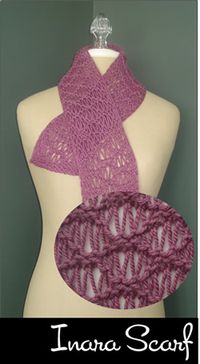
Inara Scarf

Falling in love with the ease of the drop stitch patterns. They create lovely projects and they are done super fast. Here is another take at the drop stitch.

Inara Scarf


Download the pattern and start creating a lovely scarf, or shawl. 

Looking for other Drop Stitch Patterns? Check out the Drop Stitch Scarf Pattern 


Free Patterns Part 2

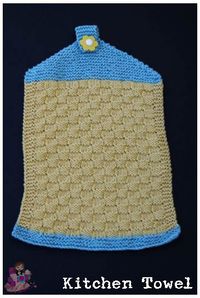
Kitchen-towel

Hostess Towel Set

Box Stitch Cloth

Tulip Facecloth

Falling for Fall Socks

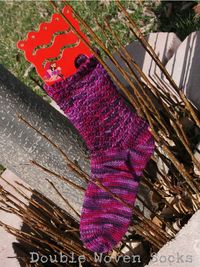
Double Woven Socks

Kaylinn Clutch

Felted-Slippers

Golf Club Cover KB

Mimirose scarf

Quick and  Nifty Cowl

Storybrook cloche

Lilys Pixie Hat

Frilly Girly skirt for KB

All-n-One Knitting Loom Launch by Authentic Knitting Board Company

All one one 2 jpg

The All-n-One knitting loom by the Authentic Knitting Board company.

We have all been waiting for the much anticipated release of this new knitting loom by the KnittingBoard.com company. I have had the pleasure to work and create with this knitting loom for the past two months.

The moment it arrived, I rushed to open the box and was immediately in love with the knitting loom. Hundreds of design possibilies came to mind. It is a knitting loom that can go from making a little itty bitty baby bootie to a shawl, even a blanket!

Down to the knitty gritty of the loom. Gauge: it is small gauge, pegs are at 3/8″ apart. The knitting loom consists of 2 long rails (48 pegs on Kids and all n one loom 028each rail), 2 sliders–with 5 pegs each slider, for a total peg configuration of 106 pegs. It also comes with two spacers to use the knitting loom as a knitting board. The pegs are made out of nylon, giving the user a very smooth peg to slide your knitting tool on. Speaking of the peg–it is grooved to facilitate knitting and the pegs also have a small cap at the top to prevent the yarn from accidentaly sliding off the peg. The knitting loom itself is made of hardwood giving you a solid, strong loom. The wood has been varnished to provide you with a smooth, glide-your-hands-on-me knitting loom.

All-n-One loom will include the following:

  • 2 long rails (48 pegs each)
  • 2 sliders (5 pegs each)
  • 2 spacers
  • Knitting tool
  • Booklet with basic instructions and patterns.

The knitting loom is a delight to work on. It is so smooth to the touch and since it is made out of Allnone-2wood, it feels warm the more you use it. The pegs are smooth but not so smooth as to make the yarn pop off the top. They have enough grab for the yarn to stay on but yet smooth enough so the knitting tool slides easily on it. Adjusting it was a breeze too. All you have to do is loosen the wing nuts at the ends and slide the slider up/down, tighten the wing nut and you are good to go.

And now that I told you all about the knitting loom, let me show you what I have created on it so far.

AllnOneProjects1

Three of the patterns are available through the KnittingBoard.com website, in the free pattern section, the Lacy Shawl and the Cowl. The purple hat instructions come with the knitting loom.  Look for another pattern (the slouchy hat in the center) coming shortly.

 I have used DK weight yarn (the gray hat that my daughter NyNy is modeling and it gives me an impressive 11 sts per in. Worsted weight, I had 9.5 sts per inch.

Here are some quick numbers for your use:

Hats with Worsted Weight yarn

Adult Men: 88 pegs

Women S/M/L: 76/80/84 pegs

Youth: 72

Children: 64

Toddlers: 60

Baby: 54

As I play more with the knitting loom, I will be posting peg numbers for socks and other basic items.  Coming next…the Last Minute Slouchy Hat!